
Whether you realise it or not humans are very good at finding the path of least resistance. There are many terms that you could use, I guess lazy might be one although sometimes it is sub-conscious decisions as well.
For a long time I have been fascinated by a human condition whereby someone finds a successful method, routine or swing thought which works really well. At some point the person will stop doing it. I am sure you would be able to think of an example where something you have done well you are now not doing. Weird, huh!
Well I think that is also related to this ‘path of least resistance’. I can give you a few examples of how it affects me.
Firstly, as a golfer and golf coach it can affect the way that we swing the golf club. Here I am talking about your biomechanics and your ability to consistently make a movement. You see if you want to make a complete 90 degree shoulder turn and maintain good form and balance then you will need to have enough flexibility through your spine and you would also need to be able to rotate your neck by 90 degrees.
If you give yourself the command to make a ‘full turn’ and are not flexible enough to do that then your sub-conscious brain is going to have to find some alternatives for you. So think of the golfer that is trying to make a full turn but is lacking in flexibility. One thing you may notice is that the left heel may come away from the ground slightly in the backswing. That movement is your brain finding a path that has less resistance and it is fooling you into thinking that your shoulders have now rotated by 90 degrees. The reality is more like you got to 70 degrees, your spine reached it maximum rotation, your left heel raised up slightly which allowed the rest of your body to turn and give the appearance that a complete shoulder turn has been made. This is just one example.
These extra sub-conscious movements can be destructive to consistency because, firstly you are not aware of them and secondly the more moving parts that have to be managed the more skill and practice you will need to maintain them. When I am coaching I refer to these as ’high maintenance moves’.
Because of the need for good levels of flexibility and stability needed in golf I regularly see a golf biomechanic/personal trainer who sets me a program to keep my body functioning for golf movements and general well being. She is excellent at diagnosing the strengths and weakness in my movements and can also spot when my brain decides to take the ‘path of least resistance’ to perform an exercise.
The most recent example would be that my right gluteus muscle is weaker than my left so if I try to hold a plank position my right hip will try to drop.
By using a coach to help me work on my biomechanics and fitness I can tell you that the workout with her is so much more intense than if I workout on my own. I certainly don’t push my self as hard, even if I think I am! That is where coaching is definitely needed for golfers to try and remove some of the ‘high maintenance moves’ that can interrupt consistency. Even more important than that, good coaching should help to discover the movements that you are trying to make that your body is not able too! This is an area of coaching that I am looking to continue learning about.
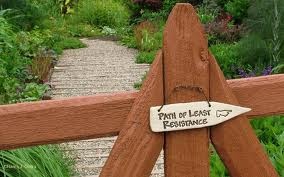
So when you see a signpost that points to ‘the path of least resistance’, turn the other way!
 neal granville golf